Hair · condition guide
Fenugreek Seeds for Hair: How to Use Them and What to Expect
Before you start: Fenugreek can cause allergic reactions, including in people allergic to peanuts. Do not take fenugreek supplements if you are pregnant. Taken by mouth in large doses, it can lower blood sugar, so check with your doctor if you take diabetes medicines. See a doctor for sudden, patchy or fast hair loss. Betterment Daily is educational and is not medical advice. Talk to your doctor or pharmacist before starting a supplement. Medical disclaimer.
In this article
Fenugreek seeds are one of the most shared home remedies for hair fall, especially in South Asian households. The evidence behind them is thin: we found no controlled trial of fenugreek for hair loss in PubMed, and the claims rest on plant chemistry and lab work. Used on the scalp, fenugreek is low-risk for most people, but it is a legume allergen and is not a safe supplement in pregnancy. Below we explain how people use it, what is and isn’t known, and what has better evidence.
Does fenugreek help hair? The evidence so far
Fenugreek (Trigonella foenum-graecum) is a plant whose seeds smell and taste like maple syrup and have long been used as a spice and a traditional medicine.
The hair claims come from a few directions, all of them early-stage:
- Hormone theory. Fenugreek seeds have had wide publicity on social media as a plant-based antiandrogen, a substance that blocks male hormones linked to pattern hair loss. A 2022 review of hair oils notes that a compound in fenugreek, diosgenin, has estrogen-like activity that may lower DHT, but adds that the mechanism is not properly known.
- Dandruff theory. The same review cites lab work in which a diluted fenugreek extract reduced Malassezia furfur, a yeast linked to dandruff. That was a lab test, not a scalp study.
- Conditioning. Fenugreek contains lecithin, which the review describes as a natural emollient that may help moisturize hair.
What is missing is a controlled trial. A 2025 review of blinded, controlled trials of non-prescription products for pattern hair loss found 13 studies covering procyanidin, cetirizine, caffeine, rice bran, pumpkin seed oil, rosemary oil, saw palmetto and watercress. Fenugreek was not among them. Evidence: Insufficient.
A small trial of an oral fenugreek product is often quoted online, but we could not find it in PubMed, so we cannot check its methods or results.
How to use fenugreek seeds: three methods
None of these methods has been tested in a trial. They are traditional uses, and the main differences are time and mess:
| Method | Time | Mess | Notes |
|---|---|---|---|
| Paste mask | Overnight soak, then 30–45 min on the scalp | High: grainy paste, hard to rinse | The most common method |
| Soaking water rinse | Overnight soak, 5 min to apply | Low | Easiest; weakest “dose” |
| Infused oil | Seeds warmed in a carrier oil, strained | Medium: oily | Store small batches; discard if it smells off |
Whatever you choose, do a patch test first (see the safety section below).
Making a fenugreek paste mask
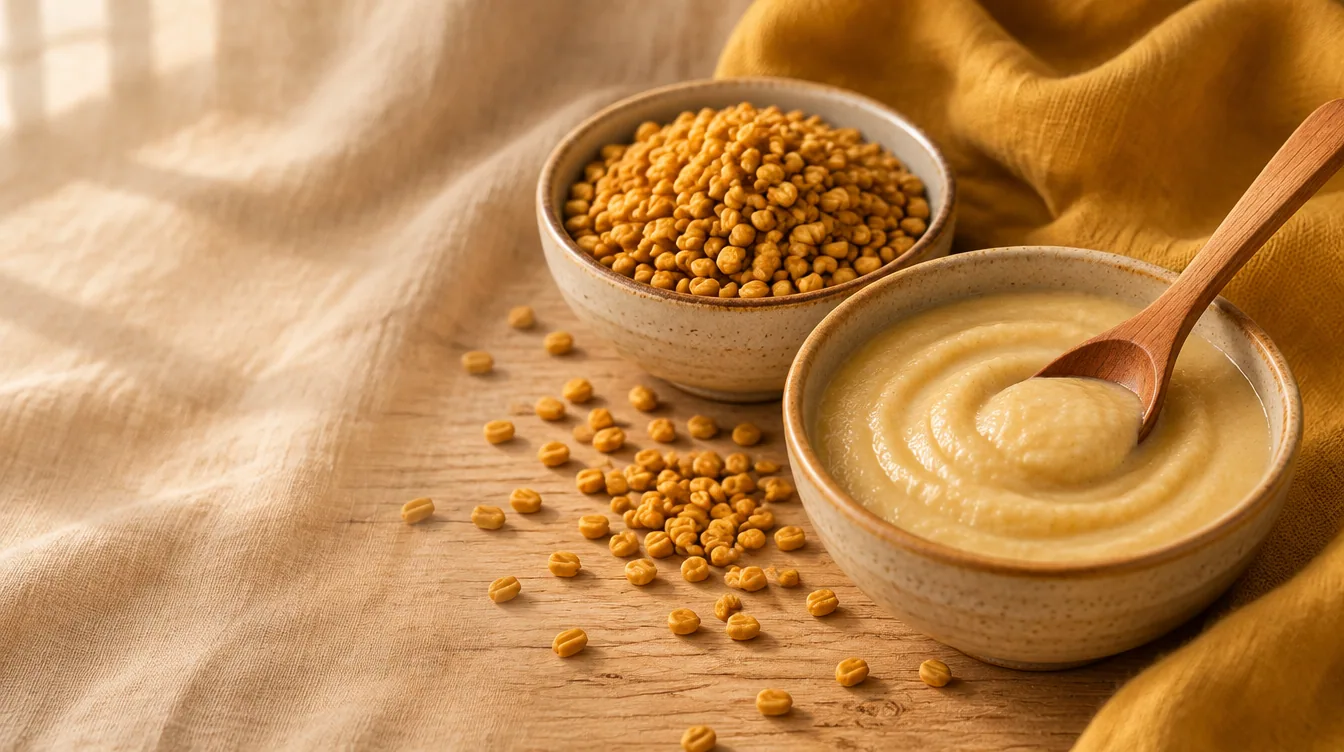
- Soak. Cover 2 to 3 tablespoons of fenugreek seeds with water and leave them overnight. They swell and turn slippery.
- Grind. Blend the soaked seeds into a smooth paste, adding a little of the soaking water if needed.
- Apply. Part your hair and spread the paste over the scalp, then along the lengths if you like.
- Wait. Leave it for 30 to 45 minutes. Longer usually just means a drier paste that’s harder to wash out.
- Rinse. Rinse thoroughly with lukewarm water, then shampoo. Expect to find seed bits for a wash or two.
Some people mix the paste with yogurt or coconut oil to make it easier to spread. That changes the texture, not the evidence. If your scalp stings, itches or turns red, rinse it off and stop.
Fenugreek rinse and oil
Rinse. Soak a tablespoon of seeds in a cup of water overnight, strain, and pour the water over the scalp after shampooing. Some people leave it in; others rinse after a few minutes. This is the least messy option and the easiest to stick with.
Oil. Gently warm a few tablespoons of seeds in a carrier oil such as coconut oil for a few minutes, let it cool, strain and store in a clean jar. Massage a small amount into the scalp before washing. Homemade oils have no preservatives, so make small batches.
Both leave a maple-like smell for some hours. That smell comes from the seeds themselves and is harmless.
Fenugreek supplements for hair
Some people take fenugreek capsules instead of, or as well as, using it on the scalp. Taken by mouth, fenugreek acts more like a medicine than a hair product, and the safety notes are more important:
- Blood sugar. Research has suggested that fenugreek may help lower blood sugar in people with type 2 diabetes, and large doses may cause a harmful drop. If you take diabetes medicines, talk to your doctor before taking it.
- Pregnancy. Fenugreek is not safe in pregnancy in amounts greater than those in food; it has been linked to birth defects in animals and people.
- Breastfeeding. Little is known about the safety of supplement-level amounts while breastfeeding.
- Digestion. Side effects include diarrhea, nausea and other digestive symptoms. A scoping review of 60 articles found mild digestive discomfort was the most common adverse effect, along with hypoglycemia, allergic reactions and interactions with some medicines.
What to check on a capsule label
If you do buy a fenugreek supplement, the label should tell you:
- How much fenugreek per capsule, and whether it is whole ground seed or a concentrated extract. Extracts can be much stronger per milligram.
- What else is in it. Many “hair” products combine fenugreek with biotin, zinc or other herbs, which makes it harder to know what you are reacting to.
- Allergen warnings. Look for a legume or peanut cross-reactivity warning if you have food allergies.
- Independent testing. A seal from a third-party testing organization shows the product contains what the label says, though it says nothing about whether it works.
We cover oral fenugreek in more detail in fenugreek supplements for hair growth. If you are looking at supplements for thinning hair more broadly, see biotin for hair growth and vitamins for hair loss in women.
Fenugreek vs rosemary for hair growth
Rosemary oil is the other kitchen-cupboard hair remedy, and it has more evidence:
| Row | Fenugreek | Rosemary oil |
|---|---|---|
| Controlled trials for hair loss | None found | One trial: 100 people, 6 months, compared with 2% minoxidil |
| Result | Not tested | Hair count rose in both groups at 6 months, with no difference between them |
| Side effects noted | Allergy, odor | Scalp itching rose in both groups, more often with minoxidil |
| Evidence | Insufficient | Limited |
The rosemary trial had no placebo group, so it can’t rule out hair improving for other reasons, and it has not been widely repeated. It is still one more trial than fenugreek has. If you want a topical remedy with some evidence behind it, rosemary oil is the stronger pick; you can use both if you tolerate them.
How long to try it
Hair grows slowly, so any remedy needs months to judge. In the rosemary trial, neither rosemary nor minoxidil changed hair count at 3 months; both showed gains at 6 months.
There is no equivalent data for fenugreek. If you try it, take a photo in the same light every month and give it at least 6 months before deciding. If you see nothing after that, there is little reason to continue.
Side effects and patch testing
Allergy. Fenugreek can cause allergic reactions, including serious ones. It is a legume, in the same family as peanut and chickpea.
Lab testing has shown fenugreek allergy caused by cross-reactivity with peanut, and case reports describe reactions in people with peanut allergy. A review of legume allergens lists chickpea and fenugreek among emerging allergen sources. If you are allergic to peanuts or other legumes, avoid fenugreek on your skin and in supplements unless an allergist has cleared it.
Patch test. Before a full mask, dab a little paste behind your ear or on the inside of your elbow and leave it for 24 to 48 hours. Skip fenugreek if you get redness, itching or swelling.
Maple syrup smell. Taken by mouth, fenugreek can make sweat smell of maple syrup. The scoping review also lists the odor in the urine, sweat or skin of infants and mothers.
In one case report, mothers who ate fenugreek during labour had newborns with a maple syrup odor that led to a false suspicion of a rare metabolic disease. It is harmless, but tell your midwife or doctor if you have been taking fenugreek near your due date.
When hair loss needs a doctor
Home remedies are reasonable for gradual thinning, but some hair loss has a medical cause. MedlinePlus lists thyroid disease, anemia, alopecia areata and hormone changes among the causes, and advises contacting a health care provider if you have:
- Hair loss in an unusual pattern, or bald spots
- Rapid hair loss, or hair loss at an early age
- Pain or itching with the hair loss, or a red, scaly scalp
- Acne, facial hair or an abnormal menstrual cycle alongside the hair loss
Our hair supplement guides cover what has better evidence, including hair growth vitamins for women. For other plant ingredients, see our ingredient guides.
Bottom line
Fenugreek seeds are a cheap, traditional hair remedy without a controlled trial behind them. The theories (hormone blocking, dandruff and conditioning) come from lab and chemistry work.
On the scalp, the main risks are allergy, especially if you react to peanuts, and the mess. As a supplement, fenugreek can lower blood sugar and should not be used in pregnancy. If you want a home remedy with at least one trial behind it, rosemary oil has the stronger case; for sudden or patchy hair loss, see a doctor.
Frequently asked questions
How do I use fenugreek seeds for hair growth?
Which is better for hair growth, rosemary or fenugreek?
What are the downsides of using fenugreek on hair?
How long does fenugreek take to grow hair?
Can I leave fenugreek on my hair overnight?
Sources
- NCCIH: Fenugreek
- Hair oils: indigenous knowledge revisited. Int J Trichology. 2022
- Gupta AK et al. Do non-prescription products help in managing androgenic alopecia? Skin Appendage Disord. 2025
- Panahi Y et al. Rosemary oil vs minoxidil 2% for the treatment of androgenetic alopecia: a randomized comparative trial. Skinmed. 2015
- Amiri Ardekani E et al. Exploring the adverse effects of fenugreek in humans: a scoping review. Iran J Med Sci. 2026
- Takei M et al. Fenugreek allergy caused by cross-reactivity with peanut: an in vitro analysis. J Allergy Clin Immunol Glob. 2024
- Che CT, Douglas L, Liem J. Case reports of peanut-fenugreek and cashew-sumac cross-reactivity. J Allergy Clin Immunol Pract. 2017
- Legume allergens pea, chickpea, lentil, lupine and beyond. Curr Allergy Asthma Rep. 2024
- Mebazaa R, Rega B, Camel V. Analysis of human male armpit sweat after fenugreek ingestion. Food Chem. 2011
- Korman SH et al. Pseudo-maple syrup urine disease due to maternal prenatal ingestion of fenugreek. J Paediatr Child Health. 2001
- MedlinePlus: Hair loss