Ingredients · ingredient guide
Quercetin and Zinc: What the Pairing Can and Cannot Do
Before you start: Zinc nasal gels and sprays have been linked to long-lasting or permanent loss of smell. Keep total zinc at or below 40 mg a day unless your doctor advises more, and space zinc away from quinolone and tetracycline antibiotics. Neither supplement treats or prevents COVID-19. Betterment Daily is educational and is not medical advice. Talk to your doctor or pharmacist before starting a supplement. Medical disclaimer.
In this article
Quercetin and zinc are sold together because of one idea: that quercetin helps zinc get inside cells. That idea comes from lab experiments. In people, the stronger evidence is for zinc lozenges taken early in a cold, and quercetin on its own shows small, mixed effects. We found no human trial that tested the two as a combination.
This guide explains where the claim came from, what the trials showed and how to stay within safe zinc limits.
Why people pair quercetin and zinc
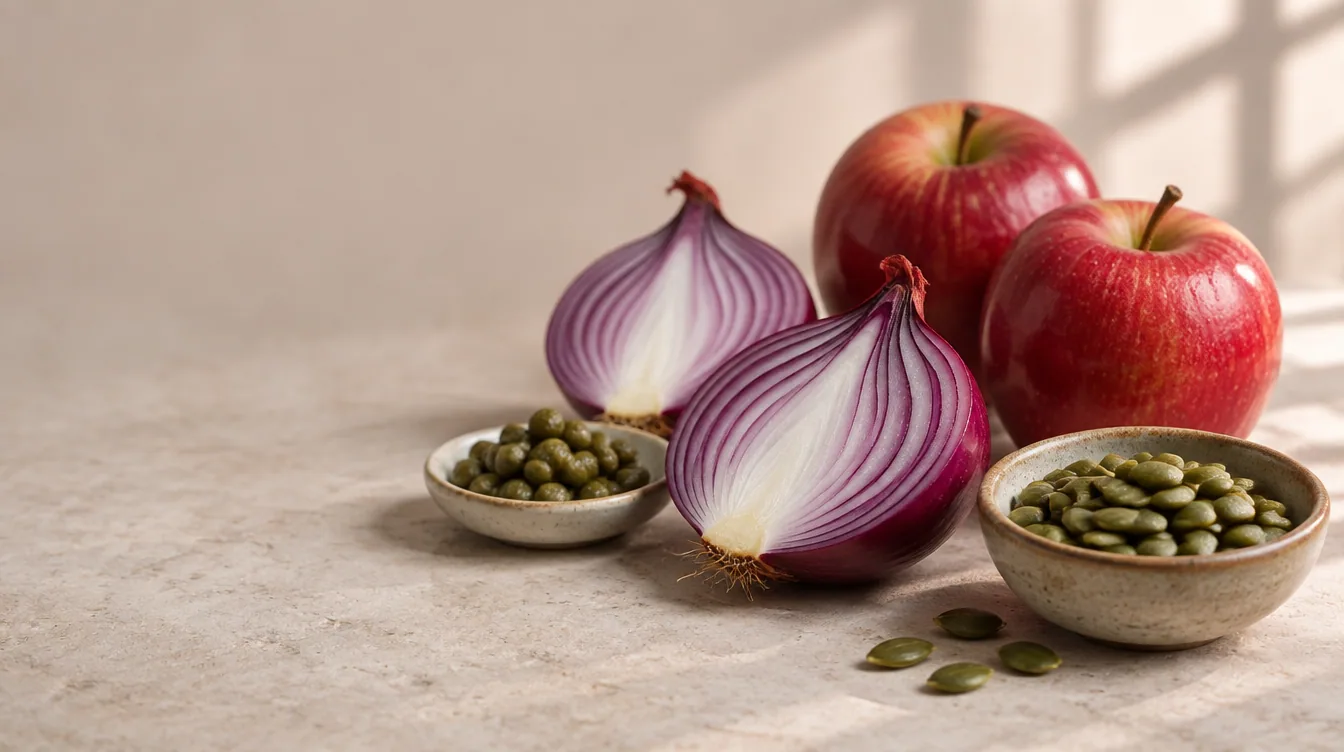
Zinc is a mineral the body needs for immune function, wound healing and the senses of smell and taste. Quercetin is a flavonoid, a plant pigment found in foods such as onions, apples and capers, and sold as a supplement, often at doses up to 1,000 mg a day, well above what a normal diet provides.
The pairing became popular during the COVID-19 pandemic, when the “zinc ionophore” idea spread online. Zinc products were already widely used for colds, so adding quercetin looked like a way to make zinc work better. That is the claim worth checking.
The zinc ionophore idea, explained
An ionophore is a molecule that carries a charged particle, such as a zinc ion, across a cell membrane. The idea is that more zinc inside a cell could interfere with viruses copying themselves.
The key experiment was published in 2014. Researchers showed that quercetin rapidly increased free zinc inside mouse liver cancer cells and inside liposomes, which are artificial fat bubbles used to model a cell membrane. Zinc only crossed the membrane when quercetin and zinc were added together. Evidence: Insufficient for any health effect, because this was cell and membrane chemistry, not a study in people.
What the experiment did not show:
- That quercetin taken as a supplement reaches cells at the concentrations used in the lab.
- That more zinc inside cells protects against any infection in a living person.
- Anything about viruses. The 2014 study did not test viruses at all.
A later lab study looked at the virus question directly. In cultured human lung cells, quercetin lowered two proteins the COVID-19 virus uses to enter cells but had no antiviral effect. Lab results that look promising often fail to hold up in the next experiment, let alone in patients.
What human trials showed for COVID-19
Zinc was tested directly. In the COVID A to Z trial, 214 adults with COVID-19 treated at home were given zinc gluconate (50 mg a day), vitamin C (8,000 mg a day), both, or usual care for 10 days.
The trial was stopped early because none of the treatments made a meaningful difference. People on usual care reached a 50% drop in symptoms in 6.7 days, compared with 5.9 days on zinc and 5.5 days on both, a difference that was not statistically significant.
Quercetin had a more positive result in one trial. In Pakistan, 100 outpatients with early, mild to moderate COVID-19 received usual care alone or usual care plus a lecithin-based quercetin product (500 mg, three times a day in week one and twice a day in week two). After a week, 34 in the quercetin group tested negative compared with 12 in the control group.
But the trial was open-label (everyone knew what they were taking), it was small, and several authors worked for the company that makes the product. Evidence: Limited.
Neither trial tested quercetin and zinc together. Neither supplement is a treatment for COVID-19, and neither replaces vaccination or medical care.
Zinc and colds: the better-studied use
The strongest human evidence for zinc is in the common cold. A 2024 Cochrane review pooled 34 trials with 8,526 participants:
- Prevention: taking zinc regularly may make little or no difference to whether you catch a cold.
- Treatment: taking zinc once a cold has started may shorten it, by an average of about 2.4 days in the pooled trials, but the results varied widely between trials and the certainty was low.
- Side effects: treatment with zinc probably increases mild side effects such as nausea and a bad taste.
Most treatment trials used lozenges, mainly zinc gluconate or acetate. The gluconate doses ranged from 45 to 276 mg a day for 4.5 to 21 days, short courses that sometimes went above the long-term upper limit. Evidence: Limited for shortening a cold; Moderate that it doesn’t prevent colds. None of these trials added quercetin.
Quercetin on its own
Quercetin has been tested for a handful of outcomes, with modest results:
| Outcome | What trials found | Evidence |
|---|---|---|
| Colds after heavy exercise | 40 trained cyclists took 1,000 mg a day or placebo; 1 of 20 vs 9 of 20 got a respiratory infection in the 2 weeks after 3 days of hard cycling | Limited |
| Systolic blood pressure | About 2 mmHg lower across 10 trials (841 people) | Limited |
| Cholesterol, glucose, inflammation | No effect in an umbrella review of meta-analyses | Moderate (no effect) |
The cyclist trial is often quoted, but it was small and in a very specific setting. The same trial found quercetin did not change any of the immune markers it measured. More on single-ingredient quercetin is in our quercetin benefits guide, and on zinc forms in our zinc supplement guide.
How much and when
| Row | Zinc | Quercetin |
|---|---|---|
| Doses studied | Lozenges 45–276 mg a day for a few days (colds); 50 mg a day for 10 days (COVID A to Z) | 1,000 mg a day for 3 weeks (cyclists); 1,000–1,500 mg a day of a lecithin form (COVID trial) |
| Daily ceiling | 40 mg a day from all sources, the US upper limit (Europe sets 25 mg) | No official upper limit; no adequate data beyond 12 weeks at 1,000 mg or more |
| Timing | Can cause nausea; many people tolerate it better with food. Separate from quinolone and tetracycline antibiotics | Not studied |
Sources: Cochrane zinc review, zinc limits review, quercetin safety review.
The zinc ceiling counts everything: multivitamins, cold lozenges, fortified foods and any combination product. A zinc-quercetin capsule plus a multivitamin can reach the limit faster than people expect. Our quercetin dosage guide covers quercetin amounts in more detail.
Getting quercetin absorbed
Plain quercetin dissolves poorly and is absorbed badly. In a 12-person crossover study, a lecithin-based form reached plasma levels up to 20 times higher than unformulated quercetin. The authors worked for the company that makes that form, and higher blood levels don’t automatically mean more benefit. Quercetin is also often sold with bromelain, an enzyme from pineapple; we look at that pairing in quercetin with bromelain.
This matters for the ionophore claim. If plain quercetin barely reaches the bloodstream, the concentrations used in the 2014 cell experiment are unlikely to be reached in your tissues from a standard capsule.
Side effects and interactions
Zinc:
- Long-term excess can cause copper deficiency, reduced immunity and lower HDL (“good”) cholesterol. MedlinePlus adds that it can also lead to iron or magnesium deficiency. A review of zinc toxicity lists anemia and low white blood cell counts (neutropenia) among the effects of too much zinc.
- Stomach upset: large doses can cause diarrhea, abdominal cramps and vomiting.
- Nasal zinc: zinc gels and swabs used inside the nose have been linked to long-lasting or permanent loss of smell, and the FDA warned consumers to stop using several such products in 2009. Oral lozenges are a different product, but avoid anything sprayed or swabbed into the nose.
- Antibiotics: zinc binds to some antibiotics and reduces how much is absorbed. MedlinePlus advises taking zinc-containing products at least 6 hours before or 2 hours after ciprofloxacin, and spacing them from tetracycline as well. Zinc may also interact with penicillamine, a drug used for rheumatoid arthritis.
Quercetin:
- Across published human trials, side effects have been rare and mild.
- Kidneys: in animal experiments, quercetin made damage worse in kidneys that were already injured. If you have kidney disease, check with your doctor first.
- Drug interactions: in short-term animal and human research, quercetin changed how much of certain drugs reached the bloodstream. If you take prescription medicines, ask a pharmacist before starting it.
- Long-term use: there are no adequate safety data for 1,000 mg or more taken for longer than 12 weeks.
Who should skip it
- People with kidney disease, given the animal findings above.
- Anyone on antibiotics or penicillamine, unless a pharmacist has set the timing.
- People already taking zinc in a multivitamin or cold product, who could go over the limit.
- Pregnant or breastfeeding women. We found no safety data for quercetin supplements in pregnancy, so we would avoid them.
If you are taking this pairing because of an infection, see a doctor if you are short of breath, have a high fever that won’t settle, or feel worse after a few days. Zinc is also covered alongside magnesium in taking magnesium and zinc together, and more single ingredients are in our ingredient guides.
Bottom line
The quercetin-and-zinc pairing is built on an idea from lab experiments that has not been tested as a combination in people. Zinc lozenges started early may shorten a cold by a day or two, with more nausea. Quercetin may lower blood pressure slightly and is absorbed poorly unless specially formulated. If you take either, keep total zinc at 40 mg a day or less, avoid nasal zinc products, and separate zinc from antibiotics.
Frequently asked questions
Can you take zinc and quercetin together?
What are the benefits of taking zinc and quercetin together?
What is the downside of quercetin?
What time of day should you take quercetin and zinc?
Should you add vitamin C and D3?
Sources
- Dabbagh-Bazarbachi H et al. Zinc ionophore activity of quercetin and epigallocatechin-gallate: from Hepa 1-6 cells to a liposome model. J Agric Food Chem. 2014
- Houghton MJ et al. The flavonoid quercetin decreases ACE2 and TMPRSS2 expression but not SARS-CoV-2 infection in cultured human lung cells. 2024
- Thomas S et al. Effect of high-dose zinc and ascorbic acid supplementation vs usual care on symptom length among ambulatory patients with SARS-CoV-2 infection: the COVID A to Z randomized clinical trial. JAMA Netw Open. 2021
- Quercetin as a possible complementary agent for early-stage COVID-19: concluding results of a randomized clinical trial. Front Pharmacol. 2022
- Nault D et al. Zinc for prevention and treatment of the common cold. Cochrane Database Syst Rev. 2024
- Nieman DC et al. Quercetin reduces illness but not immune perturbations after intensive exercise. Med Sci Sports Exerc. 2007
- The effects of quercetin supplementation on blood pressure: meta-analysis. Curr Probl Cardiol. 2022
- Arabi SM et al. The effects of quercetin supplementation on cardiometabolic outcomes: an umbrella review of meta-analyses of RCTs. Phytother Res. 2023
- Riva A et al. Improved oral absorption of quercetin from Quercetin Phytosome, a new delivery system based on food grade lecithin. Eur J Drug Metab Pharmacokinet. 2019
- Andres S et al. Safety aspects of the use of quercetin as a dietary supplement. Mol Nutr Food Res. 2018
- Schoofs H, Schmit J, Rink L. Zinc toxicity: understanding the limits. Molecules. 2024
- NCCIH: Flu and colds, in depth
- MedlinePlus: Zinc in diet
- MedlinePlus: Ciprofloxacin
- MedlinePlus: Tetracycline