Skin · condition guide
Vitamins for Dry Skin: What the Evidence Supports
In this article
- What supplements can and can’t do for dry skin
- Nutrients ranked by evidence
- Essential fats: omega-3 and linoleic acid
- Vitamin C
- Vitamin D
- Vitamin E
- Zinc and the B vitamins
- Are multivitamins worth it for dry skin?
- A dry-skin plate
- Is it dry skin or eczema?
- How to test a supplement on yourself
- Upper limits worth knowing
- Habits that do more than any pill
- When dry skin needs a doctor
- Where to go next
No vitamin reliably fixes ordinary dry skin, but a few nutrients have some support. Essential fats (omega-3s and linoleic acid) and vitamin C have the best evidence, from small trials and large diet studies. Vitamin D helped winter eczema in children. Zinc and B vitamins matter mainly if you are deficient.
That is a modest list, and it is honest. Dry skin is mostly about water leaving the outer layer of skin faster than it is replaced, and the biggest causes are weather, hot water and soap, not missing vitamins.
What supplements can and can’t do for dry skin
MedlinePlus lists the usual causes: cold or dry air, indoor heating and air conditioning, bathing too often or too long, harsh soaps, skin conditions such as eczema, some diseases (diabetes and an underactive thyroid among them), certain medicines, and ageing skin that makes less oil. Only a few of those have anything to do with diet.
Supplements can help in two situations. One is a real shortfall, where a nutrient your skin needs is missing from your diet. The other is a small, slow nudge to the skin barrier from extra essential fats.
Neither works as fast as a good moisturizer. If you suspect a deficiency, our short guide to which vitamin deficiencies cause dry skin explains the signs to look for.
Nutrients ranked by evidence
| Nutrient | What the evidence shows | Evidence |
|---|---|---|
| Essential fats (omega-3, linoleic acid) | Small trials: less water loss, better hydration | Limited |
| Vitamin C | Higher intake linked to less dryness in a diet study | Limited |
| Vitamin D | Helped winter eczema in children; plain dry skin untested | Limited |
| Vitamin E | No trials of pills for dry skin | Insufficient |
| Zinc, B vitamins | Matter when deficient | Insufficient (for non-deficient skin) |
| Multivitamin | No trials for dry skin | Insufficient |
Sources for each row are linked in the sections below: essential fats, vitamin C and vitamin D.
Essential fats: omega-3 and linoleic acid
The skin’s outer barrier is built partly from fats, so this is the most plausible nutritional lever. Evidence: Limited. In a 12-week German trial, women with sensitive skin who took flaxseed oil (a plant omega-3 source) lost less water through their skin and had less roughness and scaling, with better hydration. The groups were tiny: 13 women each.
A 2024 pair of pilot trials with about 50 adults each found that 1 g or 2 g of krill oil a day reduced water loss through the skin and improved hydration over 12 weeks. The changes were small, and the krill oil maker funded the work and employed two of the authors. A rat study found fish oil eased induced dry skin, which is a reason to keep studying it, not proof in people.
Diet data point the same way. Among 4,025 American women, those eating more linoleic acid (an omega-6 fat found in nuts, seeds and vegetable oils) were less likely to have age-related skin dryness. For the full hydration picture, including the trials of oral hyaluronic acid, ceramides and collagen, see our deep dive on supplements for skin hydration. Omega-3 dosing for skin gets its own page in omega-3 for dry skin.
Vitamin C
Diet data carry most of the case here (Evidence: Limited). In the same survey of 4,025 women, assessed by dermatologists, higher vitamin C intake went with a lower likelihood of senile dryness and a wrinkled look. That is an association in a diet survey, not a trial of pills.
The mechanism is real. Vitamin C is a cofactor for the enzymes that stabilise collagen, and severe deficiency causes scurvy, with fragile skin and slow wound healing. Most people get enough from fruit and vegetables, and we’d spend the money on an orange before a vitamin C pill for dry skin.
Vitamin D
Nobody has properly tested vitamin D on plain dry skin, so the evidence is Limited and comes from eczema. In a 2014 trial of 107 Mongolian children whose eczema flared every winter, 1,000 IU of vitamin D3 a day for a month improved eczema scores more than placebo. Those children were likely low in vitamin D, which matters.
A 2024 meta-analysis of 11 trials with 686 people also found vitamin D reduced eczema severity.
If your dry skin is really eczema, our guide to supplements for eczema covers this in detail. Keep supplements within the adult upper limit of 4,000 IU (100 mcg) a day; too much vitamin D raises blood calcium, which can damage the kidneys.
Vitamin E
Evidence: Insufficient. Vitamin E is an antioxidant and a staple of skin creams, but we found no controlled trials showing that vitamin E pills ease dry skin. A review of nutrition and skin ageing describes antioxidants like it being used “either as topically applied agents or oral supplements”, which tells you how the industry uses it, not that it works.
If you take it anyway, MedlinePlus puts the highest safe supplement dose for adults at 1,000 mg a day, and notes that high levels may raise the risk of birth defects.
Zinc and the B vitamins
Evidence: Insufficient for skin that isn’t deficient. Zinc and several B vitamins are needed for healthy skin, and a real deficiency can show up as a rash or scaling. Extra amounts in a well-fed person have not been shown to soften dry skin.
More is not harmless. Long-term excess zinc can cause copper, iron or magnesium deficiency. If you suspect a shortfall, checking for the deficiencies that cause dry skin (covered in the guide linked above) is a better first step than a high-dose pill.
Are multivitamins worth it for dry skin?
Evidence: Insufficient. We found no controlled trials of multivitamins for plain dry skin. A standard multivitamin can cover small gaps in a patchy diet, and that is the honest case for one.
It will not undo hot showers or winter air. Avoid “hair, skin and nails” formulas with very high vitamin A, which is the one skin vitamin where more can clearly hurt you.
A dry-skin plate
Food covers most of the list above without any dosing worries:
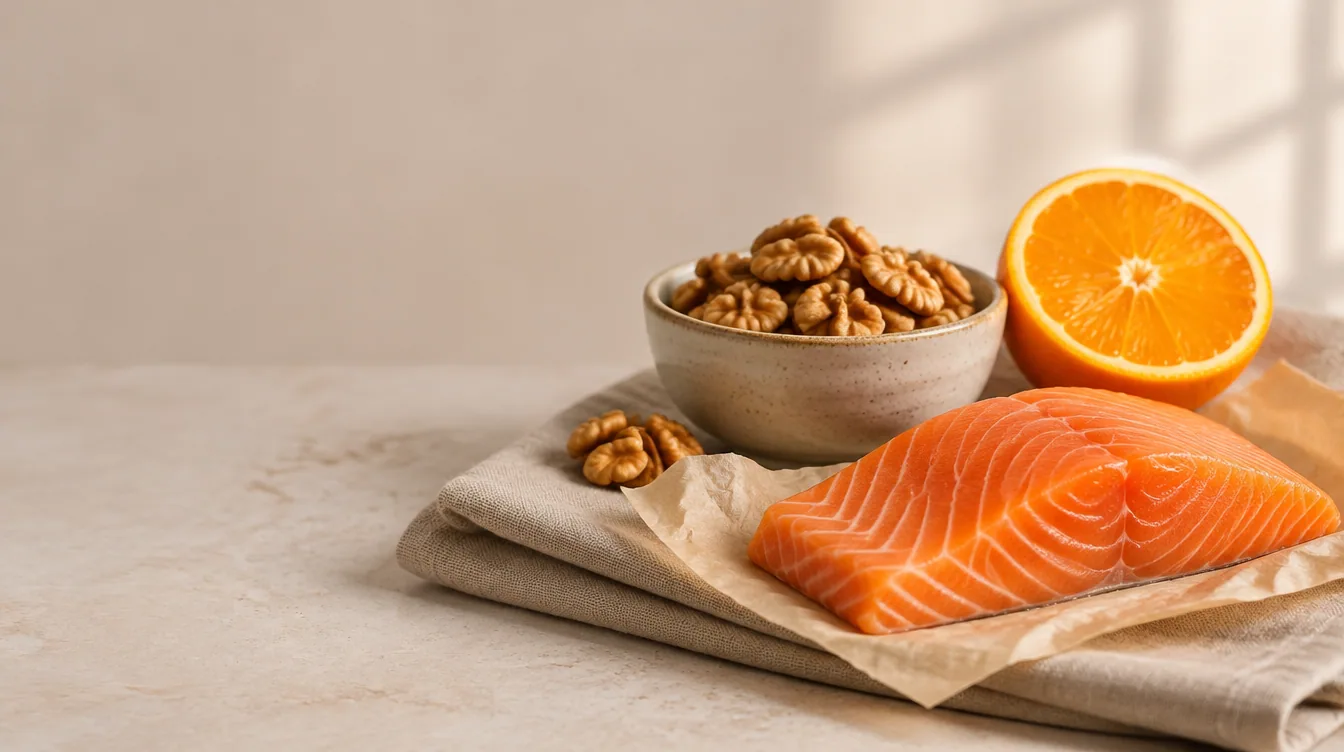
- Omega-3s: oily fish such as salmon and sardines, or walnuts and ground flaxseed
- Linoleic acid: nuts, seeds and vegetable oils
- Vitamin C: citrus, kiwi, berries, peppers and broccoli, ideally raw
- Zinc: meat and other animal proteins, nuts, whole grains and legumes
Eating this way also supports the other half of skin care: water and a varied diet. Supplements make most sense when your diet clearly can’t supply something.
Is it dry skin or eczema?
The answer changes which evidence applies. Plain dry skin feels tight and rough and may flake, but it settles with moisturizer. Atopic dermatitis, the common form of eczema, is a long-term condition with scaly, itchy rashes that can blister, ooze and crust over. It often runs in families alongside asthma or hay fever.
Winter air, long hot showers, wool and perfumed soaps make both worse. If your “dry skin” keeps coming back as red, itchy patches in the same places, treat it as eczema and see a doctor or dermatologist, because prescription creams work far better than any supplement.
How to test a supplement on yourself
If you decide to try something from the list above, set it up so you can tell whether it worked:
- Change one thing at a time. Starting fish oil, a new moisturizer and a humidifier in the same week tells you nothing.
- Give it about three months. The fat trials above ran for 6 to 12 weeks before measuring anything.
- Take a photo of the same patch of skin, in the same light, at the start and at the end.
- Stop if nothing has changed. A supplement that hasn’t helped by then is unlikely to start.
Upper limits worth knowing
| Nutrient | Upper limit or warning for adults |
|---|---|
| Vitamin A | Chronic poisoning can occur above about 33,000 IU a day; large doses in pregnancy can cause birth defects |
| Vitamin D | 4,000 IU (100 mcg) a day |
| Vitamin E | 1,000 mg a day from supplements |
| Zinc | Long-term excess can cause copper deficiency |
Sources: MedlinePlus pages for vitamin A, vitamin D, vitamin E and zinc.
Vitamin A deserves special care in pregnancy. If you are pregnant or trying to conceive, don’t add a separate vitamin A supplement unless your doctor advises it.
Habits that do more than any pill
The MedlinePlus self-care advice is simple and effective. Moisturize with an ointment, cream or lotion two to three times a day. Keep baths and showers short and warm, about 5 to 10 minutes, rather than hot. Look for moisturizers with ceramides, and soothe itchy patches with moisturizer and a cool compress.
We would do all of that before buying a supplement. If you still want a supplement, add it on top, give it three months, and judge it honestly.
When dry skin needs a doctor
Contact a health professional if you itch without a visible rash, if dryness and itching keep you awake, if scratching has left open cuts or sores, or if self-care doesn’t help. Widespread dryness that comes on suddenly can point to a condition such as an underactive thyroid or diabetes, which a doctor can test for.
Where to go next
For oral hyaluronic acid, ceramides and collagen, read the hydration deep dive linked in the essential-fats section. If you think a deficiency is behind your dry skin, start with the deficiency guide linked near the top. For everything skin-related, the skin hub lists our guides, including collagen for skin. If you are in your 40s, our guide to vitamins for women over 40 covers the wider picture.
Frequently asked questions
What vitamins are best for dry skin?
Do multivitamins help dry skin?
How long do supplements take to improve dry skin?
Can too many vitamins make skin worse?
What does vitamin E do for skin?
Sources
- Cosgrove MC et al. Dietary nutrient intakes and skin-aging appearance among middle-aged American women. Am J Clin Nutr. 2007
- Neukam K et al. Supplementation of flaxseed oil diminishes skin sensitivity and improves skin barrier function and condition. Skin Pharmacol Physiol. 2011
- Handeland K et al. Krill oil supplementation improves transepidermal water loss, hydration and elasticity of the skin in healthy adults. J Cosmet Dermatol. 2024
- Barcelos RC et al. Oral supplementation with fish oil reduces dryness and pruritus in the acetone-induced dry skin rat model. J Dermatol Sci. 2015
- Camargo CA Jr et al. Randomized trial of vitamin D supplementation for winter-related atopic dermatitis in children. J Allergy Clin Immunol. 2014
- Nielsen AY et al. Vitamin D supplementation for treating atopic dermatitis in children and adults: a systematic review and meta-analysis. Nutrients. 2024
- Schagen SK et al. Discovering the link between nutrition and skin aging. Dermatoendocrinol. 2012
- MedlinePlus: Dry skin
- MedlinePlus: Dry skin, self-care
- MedlinePlus: Atopic dermatitis
- MedlinePlus: Vitamin A
- MedlinePlus: Vitamin D
- MedlinePlus: Vitamin E
- MedlinePlus: Vitamin C
- MedlinePlus: Zinc in diet